Rio to Salvador…Hippies, Beaches, and Voodoo

Coco + Beach

THIS POST COVERS JANUARY 19TH – FEBRUARY 8TH

NOTE: To those who subscribed to the blog, instead of reading it in your email inbox its best to click above where is says “Rio to Salvador…Hippies, Beaches, and Voodoo”, this will take you to the actual blog site where the photos will be bigger and you have other options to click on links to see other photos…remember this for future posts also.  Also, I added a “Translate” option on the upper right side of the screen if anyone wants to translate this into another language.

So I hope that that little narrative in the last post gave you an idea of what life on the road was like.  So here are some quick shorthand stories, observations, and photos from the trip from Rio to Bahia (Salvador)

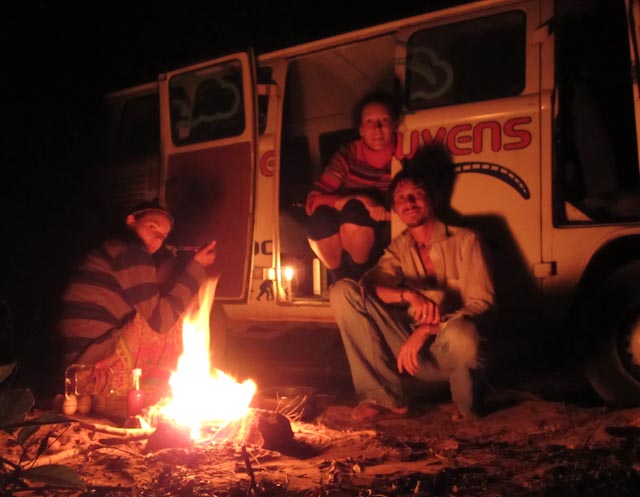
First stop after Rio was a hippie festival that Vanessa (Our couchsurfing angel in Rio) had told us about.  Its called a Rainbow Gathering and they happen all over the world and last for 30 days.  The main ideas behind these are peace, love, harmony, freedom and community (Yea…like I said, hippies.).  I had been to a very small one in Guatemala years ago and Safira had been to several.  It was more or less on the way and free so we stuck the destination into Ecowapi (the GPS) and hit the road.  It was basically what you might expect…lots of hippies living in the forest (The place was really stunningly beautiful with a nice river to swim in and waterfalls)….yoga, drum circles, dreadocks, people walking around naked, etc, etc.  These are things that I can and do relate to and feel comfortable around normally but these people were WAY into the whole thing…so much so that it was hard for me to really feel part of it.  But it was still an experience which after all is what traveling is all about.  It was interesting observing the characters in this community (some were pretty far out there) and the ideals of the community in motion.  We stayed only for two days.  Knowing that my return to reality was right around the corner, I figured “What the hell…” and I gave myself over to their way of life for the brief time I was there and had fun with it.

A hippie gathering is not complete without a tepee.

We also picked up a new passenger at the gathering…a Swiss girl named Silvina who would prove to be quite a character…often playing the role of the antagonist in the road tripping adventures that were to come.  She could be fun and spontaneous but also very opinionated and difficult.  But hey…all part of the big adventure.  So off we went, heading north.  We made lots of stops along the way, a beach here, a Buddhist monastery there, and of course passed through lots of random little town and villages stopping for gas or lunch or just to stop.  Let me pause here and say that really the meat and bones of this whole trip was seen and experienced through the windows of Coco.  The best memories I have of the whole thing were the glimpses of Brazil, the landscape and the people, all seen through the windows of the bus.  Unfortunately I was always driving so I couldn’t photograph what I saw everyday but here’s an idea:

Lots of agriculture.  The crops depended on the region with the exception of Sugarcane which was EVERYWHERE…fields as far as the eye could see.  Other times it was cacao, coffee, soybean, or palms.  In the state of Espirito Santo there was lots of eucalyptus farms.  The tree is planted in perfect rows with only about two meters between each tree. They cultivate them because they don’t need much sunlight to grow so they can plant them so close together to get a better yield form the land.  Also because they grow really fast (about 20 inches [50 cm] a month!).  They harvest them and use them for lumber, toothpicks, coal, etc.  So most of the scenery we saw between towns and cities was agricultural, the rest was either picturesque beaches and coastline, grassland for cattle, jagged green cliffs, semi-arid sand dunes or sandy scrub brush, or tropical forest and jungle.  Other common sites from the road:

  • My favorite was all the people selling things.  Sometimes staked out under small huts built from palm leaves, other times just sitting in front of table with their goods out on display.  Lots of fruit of every kind imaginable  (and lots that you could never imagine), sometimes handmade crafts, cashews, or shrimp, fish, lobster or big bags of live crabs squirming around.
  • Love Motels.  Yep…they are all over the place and very normal and socially accepted.  The fact is that many Brazilians live in the same house with several generations (kids often continue to live with their parents into their 30’s) so Love Motels are not thought of as sleazy (Although they do live up to Kitch standards with heart shaped jacuzzi tubs and mirrored walls and ceilings), but cater to couples who are just looking for a little privacy that they can’t find at home.  The best part about them is their names.  They make no qualms about what they are with names like Palácio do Prazer (Palace of Pleasure) and sometimes with Vegas like architectural themes (Mid-evil times, Egyptian, Parisian).
  • Lots of animals…cows, goats, sheep, dogs, and pigs all strolling along the highways and taking siestas between lanes.
  • Passing through small towns at night EVERYONE is out in front of their houses.  Perched on chairs or just sitting on the steps of their houses.  Sometimes just a couple sitting there in silence watching the cars go by enjoying the respite from days heat, other times a family or group of friends drinking beer and talking.  But when the sun goes down in small-town-Brazil, life happens on the front steps, not in front of the TV.
  • Capoeira…this is like a blend of martial arts and dance that has been around in Brazil since the 1500’s (!!!).  Two people enter a circle about 15 ft. in diameter and combine acrobatics, kicks, and leg sweeps into what looks like a artistic mock fight.  The further north I went the more you would see of it.  In small towns you would see the circles marked out in the dirt or sometimes they would be concrete circles.  This is where they would have public capoeira matches.
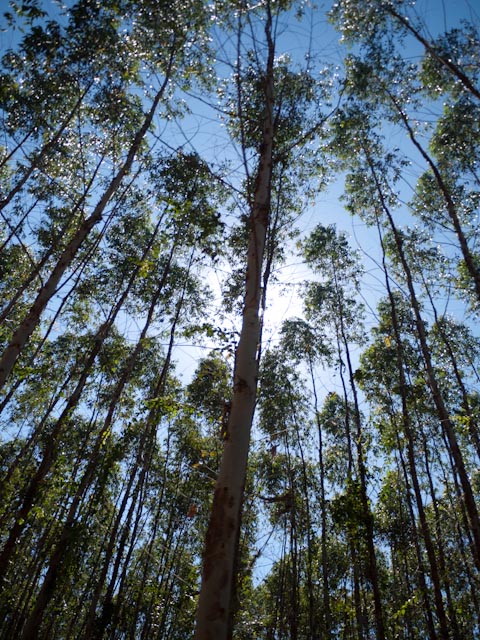
Ucalyptus Trees
Eucalyptus Trees
This is a sign for a love motel. Translation "If your boyfriend doesnt want to come, bring someone else!...Super Promotion: 2 hours for $12...Free glass of wine"
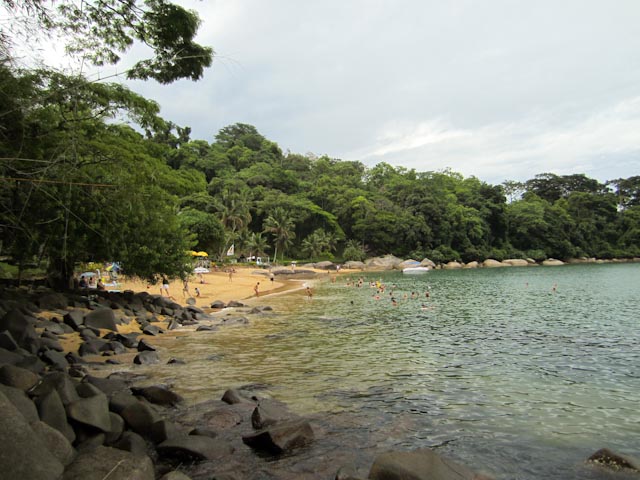
Praia Grande (we camped on this beach)

Other little stories from this leg of the trip…

There was the time when we got pulled over by the police on the highway.  Two cops got out of their cars shouting at us in Portuguese with their guns drawn and pointed at us.  Turns out a farmer had seen us parked near his property and thought we might be up to no good so he called in a description of our car.  Once the cops saw we were just some dumb gringos on a roadtrip he was actually cool and just explained to us that we need to be careful about choosing places to sleep in the car.  He wished us a safe trip and sent us on our way

One amazing memory was when we stopped in a tiny town on the ocean called Itaunas.  We had to drive for almost an hour on a dirt road (flanked on both sides by cultured eucalyptus forests) to get there.  First thing we saw when we pulled into town was a place selling homemade ice cream.  We chat it up with the guy working there who happens to be the owner and who was really cool.  He gives us a behind the scenes tour of how he makes the ice cream and lets us taste all sorts of flavors and then we tell him we are going to the beach nearby he just says “Give me five minute to close up the store and ill take you to a better beach”.  So he just closes up the store (at noon on a Sunday) tells us to jump in his car and the next thing you know we are driving down dirt roads passing beers back and forth an on our way to some secluded beach.  So we hang out there for a while then he tells us he has a fish the size of your arm in his freezer and suggests that we cook while he reopens the store.  So we ended up having this huge feast and drinking caipirinhas (and we got to use his shower!!!…I think it was out first proper shower in 4 days).

Us with the ice cream guy (I forgot his name)

I’d say the coolest place we saw on this leg of the trip was called Itacare.  We camped on a beach that was probably in the top 5 beaches I have have seen (and Ive seen lots all over the world).  Lush rainforest meets perfect white sandy beaches and transparent blue water.  We hiked through the jungle to reach an even more secluded beach called Priahna that was like a small paradise.
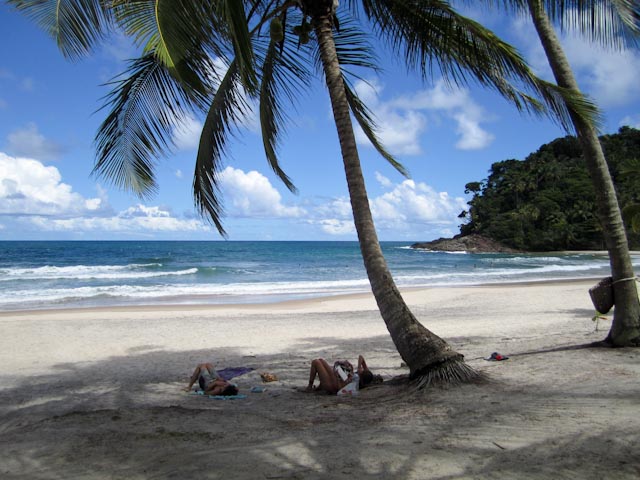
Praihna

From Itacare we headed to Salvador, a big city and one of the main attractions on any trip to Brazil.  After Rio De Janiero and the Amazon, Salvador probably draws the most tourists.  People come for the colonial and quaint historic center called Pelourihno and to get a taste of what Bahian life and culture is like (Much different from The North/Amazon or the south/Rio de Janiero).  Bahian life and culture is much more closely tied to the history and culture of the African slaves from the past.  From the music, the food, the dance, and religion, its a fascinating blend of African culture, slave history, and how it has in some ways melded with other more christian or modern ideas and traditions and in other ways has not changed at all.  The number of people who believe in and practice african voodoo (known as Macumba, Umbanda, or simple as Black Magic), is more prevalent in Salvador and got even more prevalent as I continued north.  Everyday spells are cast on enemies, hexes broken by invoking the powers of the gods, people are thrown into trances, either entered into on their own accord as a way to communicate with the gods or sometimes their bodies are taken over by evil spirits.

In Salvador Safira and I parted ways with Silvina (whew!) and we were hosted by a couchsurfer named Pablo who was a good guy, very eager to do his part in making sure we had a good time in Salvador.
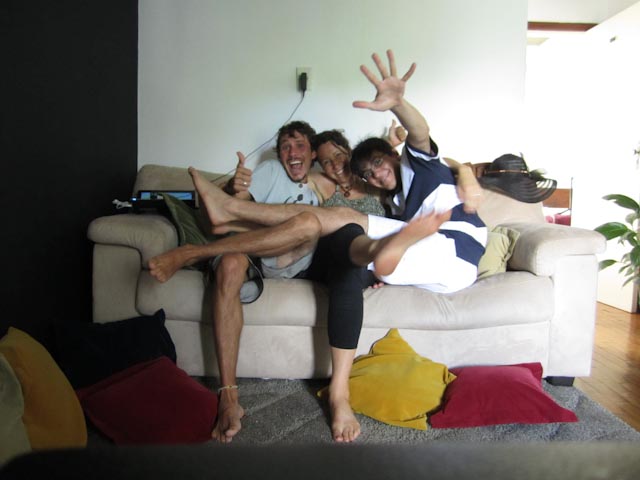
With our Couchsurfing host Pablo

We spent a lot of time wandering around the historic center which is really beautiful but also could be much more impressive with a little work and money.  This was somethng that I noticed all throughout the historic areas in the large cities of Brazil. There is no lack of cool old buildings left over from colonial times but many if not most have been left to rot with roofs that have caved in and plants and trees growing out of the windowsills.  There are others that are heading in that direction that could still be saved but it seems they have been neglected.  Basically there is lots of potential but seems very little resources.
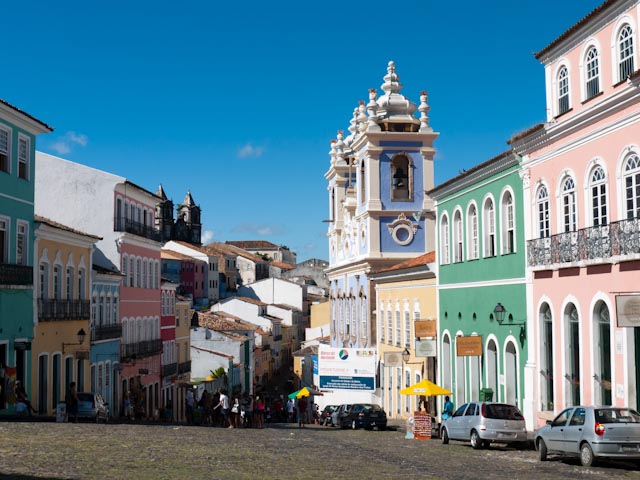
Pelourihno, the Historic Center


Coco Phones

The poverty in the city is not too hard to see although I think it has gotten better in recent years.  Crime is a huge issue in Salvador.  Most of the local couchsurfers I met don’t even stay out past 11 very often because its too dangerous to be walking around after that hour and they dont want to have to drive or take a taxi.

So Salvador was sadly where I was to loose my travel partner.  Safira had to catch a flight back to Europe so we splashed out a little bit with a departing dinner at a nice restaurant that served local food.  we shared a Vatapa with crab.  Vatapa is like a soup made from coconut milk, Dendê Oil (A very heavy orange oil made from African palms), and spices.  It was awesome!

So I said a nervous goodbye to Safira.  Nervous because I new I could count on her and her positive energy in the bus, we were old friends and traveling with her was a pleasant breeze…now I had to find new passengers to share the gas expenses!  After Safira left I spent a couple more days in Salvador with another couchsurfer, Diana and her family, her husband Tem and her Daughter Luana and they were amazing!  One of the highlights of my time in Bahia was being a part of their family for a few days.  It was so cool to see a young couple with such clear goals for themselves and for their daughter an with such discipline in achieving those goals.  They lived in well cared for but modest home in a very working class neighborhood far from the center that made me think as i drove through it…”Now this is the real Salvador!”.  Diana had a great sarcastic wit, Tem was calm and gentle, and Luana was fun and bubbly.  I also got to know their close friend Aline who is the kind of person you like immediatly.

Aline, me, Luana, Tem, & Diana

Ill leave you now to look at the other photos from the trip which tell the tale much better than I do.  Note that a lot of the photos on the Flickr site have descriptions underneath them that will explain what you are looking at or tell the story behind the picture.  Click here to see more pictures:   http://www.flickr.com/photos/59170494@N05/sets/72157626245806676/

Note: you can click on the little pins for a description…

Brazil and Life on the Road


BRAZIL FLAG & FACTS

FACTS:

  • Just moved (Last week) from being the 8th largest economy in the world to being the 7th. (Its also the 5th largest country in the world both by geographical size and population)
  • Brazil borders 10 of the 12 other countries in South America
  • 25% of the population is below the poverty line (compared to USA- 14%, Bolivia- 30%)
  • Brazil has the worlds first sustainable biofuel economy.  In 1976 the government made in mandatory to blend tha gasoline with ethanol (at a 1 to 3 ratio) made from sugarcane.  Then, startign in 2000, every new car sold in Brazil has the capability to fun off pure Ethanol or Gasoline (That is still blended with ethanol).  Every gastation in Brazil has both Ethanol and Gasoline available and any car made since 2000 can mix these two fuels.  So if you have a half a tank of ethanol in your car one day and the next day the price of gasoline is cheaper you can fill the other half with gas and the car will run like normal.  Many cars have also been adapted ot run on natural gas which is available at about 1 in 4 gas stations.
  • Population 190,000,000

COSTS:

***Note: The costs in Brazil vary more dramatically than other countries in my experience depending on what region you are in and if you are in a major city or not.

  • Beer (1 Ltr.)- $2 US
  • Meal in cheap region- $2.50 Meal in bigger city- $4 (note, these prices are for the REAL cheapy dingy places/street food…places my brazilian friends said they would not go near…they thought I was crazy for eating at them.)
  • Hostel/Pousada in big city $18, in small town $9
  • Gallon of gas $5.55, (liter- $1.50)
  • 5 hour bus ride-  $42 (compared to 18$ in Argentina and $11 in Paraguay)

So, for those of you who missed any of the previous posts (you can alway scroll down to read them)…just a quick update.  I bought a VW Bus in Sao Paulo (named Coco) and was driving it all the way to the Amazon.  In the last post I had made it as far as Rio De Janiero where I met  up with Safira and we were about to head north in the direction of Salvador (We left Rio on January 26th…yea i know am a bit behind in the blog). I’m going to keep this post simple and just share a short narrative with you that I hope will give you a better feeling of what it was like to be traveling in and living in a Volkswagen bus in Brazil.  Sorry no new pictures uploaded on Flickr this time but I will be sending out a new post in a couple days with more stories and lots of pictures.

**************************

Every time I am woken up by the hands of the oppressive heat it’s a slow reluctant acceptance of the reality of the fact that your sleep time is over. Once you have awoken to discover the weight of humidity and heat that has burrowed into the van, making itself at home, you know that there is no returning to the land of sleep where heat and cold don’t exist, it’s time to get up and get moving.  Today was not so bad.  We had found a road off the main highway into a farmland, from there we took smaller dirt roads past fields, some plowed and unplanted, big chunks of chocolate earth waiting for water and life, others already full of endless rows of papaya trees, sugar cane, or coffee.  We had found a little space off one of these roads where we could back the bus up and not be in the way, it was ideal because there was a lime tree that was on our east side that would stave off the sun’s awakening and was surely to thank for an extra half hour of sleep.

I sit up and look around, feeling decently well rested compared to other nights that were spent in sleepless battles with mosquitoes.  I look around the bus for a bottle of water but don’t see it.  We were running low on water having used most of it the night before to cook our soup.  There are a few blood stains on the white interior walls of the van, remnants of that nights battle with mosquitoes that had infiltrated our makeshift nets meant to let air pass through the van.  The blood is still bright red, probably mine.  A perfect match with the bump that I am scratching now near my big tow.  The bastard.  A good night’s sleep on the road is measured in how many times you awaken to hear a mosquito in your ear and how many time you are able to successfully ignore it vs. the times you are flung into a rage of battle mode, ready to splatter the mosquito and its bloody prize across the white canvas of the inside of the van like a strange work of modern art.

One of my travel companions is gone.  The life of her dream state cut short by the heat she must have woken up and gone for a walk.  The other is snoring quietly in the front seat; the hand of the heat touches everyone at different hours of the morning.  I open the side doors to the van and relish the cool fresh air that greets me, air that no one else would ever describe as cool and fresh but to someone who just woke up in a Volkswagen heatbox its like jumping into a swimming pool.  I jump out of the van and walk barefoot across the dirt road to urinate in the plowed field.  I notice the dirt stuck to to my feet, your feet are like the barometer of cleanliness.  Aside from swimming in some local rivers and some jumps into the ocean, the closest thing to a shower I have had in the last 5 days is washing my hands and face with soap in a gas station or two.  But those who say that cleanliness is happiness have never lived this way.  Memories of wild dives into Brazilian jungle rivers and jumping over tropical ocean waves, that’s happiness.  But its not only happiness, its feeling alive.  Those people can have their cleanliness.   Right now I’m not thinking about when ill finally get to shower but about what river we will cross today, what remote beach we will stumble upon, waiting for our arrival with open arms of golden sand and fish cooked over a fire by the guy who just brought it in on his 10 foot boat earlier that morning, devouring it in the shade of a palm tree along with the juice from a lime and the best mango you have ever eaten in your life.  Ill shower when we reach Salvador in a few days.

I turn around to look at Coco, my van, admiring her in the early morning light.  It’s always a great pleasure to wake up and see our campsite in the first light of the morning, to see our surroundings in a new light.  Im hungry.  I always seem to be hungry, surprisingly since I don’t think I’m expending much energy these days, mostly spent behind the wheel.  Breakfast is always the same and never gets old.  Come to think about lunch and dinner rarely waver either.   For breakfast its a bowl of granola and oats and sliced banana with some powdered milk and whatever warm water we have around poured on top.  This is usually followed by whatever other fruit we have laying around, almost always mango.  Its mango season here and its no secret.  Mangos are everywhere.  Driving along the highway and through small towns you see mango trees with branches sagging to the ground laden with thousands of mangos.  If you dont feel like jumping out to pick some off the ground there is almost always some little girl sitting in on the side of the road at a little wooden table with a few buckets of mangos for sale.  A bucket of about 12 mangoes might set you back 2 Reals (about $1.20).  If nothing else its worth it just to see the smile come across the little girls face when she makes a sale.

For lunch its always sandwiches.  We buy supplies…bread, cheese, ham, cucumber, tomato, and butter and someone makes sandwiches while I drive.  For dinner its vegetable soup (couple bullion cubes, vegetables, and rice or trigo), or pasta.  Like anything you eat when you are on an adventure, it always tastes great…no matter how simple it is.

So I wander back to the car and prepare some granola and eat it.  I look in our fruit box to see what else we have.  Mangoes of course, bananas, and some pineapple we bought on the side of the road the day before.  I grab a mango and dig in, juice dripping down my chin onto the floor of the bus.  I find a bottle of water but its not potable, we had just filled it up from the sink of a gas station.  I try and clean up my sticky hands so I can brush my teeth and try to get these damn mango fibers that are always and forever stuck between my teeth.

I look at the sky…there’s a few clouds.  Would be great if they hung around for a while.  Of course Coco has no air conditioning and driving in 90 degree (32 C) heat with tropical humidity can test your patience.  I had to hang a towel on the back of the driver seat to absorb all the sweat.

I look around our little campsite and throw some dirt over the remnants of the small campfire that we cooked our soup over the night before. I find the pot charred with ash on the outside and gather up the other dirty bowls and spoons.  We’ll wash them in the ocean later.  I lay down again on the bench in the back of the bus with the map in hand.  Silvina, the Swiss girl we met at a hippie gathering a few days earlier who decided to join our crew is still snoring in the front seat.  I marvel with jealousy at how she could possibly still be sleeping with this heat.  Then I open the map.  Where should we go today?


Rio de Janiero

So the last update I posted I was sleeping in Coco (my VW bus) in Copacabana Beach….I woke up the next morning with the sun, drowning in the tropical heat of the car (this uncomfortable stifling heat has become my alarm clock once I continued traveling north in the car).  I got out of the bus to have a stroll around Copacabana to stretch my legs and see what was hidden in darkness when I arrived the night before.

What I saw was a true beach culture,  walking down the street the smell of suntan oil is everywhere, coming from the half naked bodies who stroll around as if it were perfectly normal to walk down the street barefoot in a speedo or string bikini.  Copacabana is crowded and somewhat chaotic, it’s the beach for the masses.  For me it was my introduction to Rio de Janeiro, one of the most dynamic and marvelous metropolis’ I have ever seen, a city that I am now comfortable in

There is certainly no other place like it in the world. The city (of 14,000,000 people) is surrounded by and peppered with tropical rainforests complete with toucans and monkeys.  Huge jagged cliffs with bits of lush greenery clinging to their sides jolt skyward from oceans and random neighborhoods as if the city was built amongst gigantic stalagmites, miniature mountains, and lofty hills.  Nowhere is flat, except for the blue ocean and beaches which are as much a part of the city as the buildings, roads, and people.  It truly is a beach city.  Life revolves and happens around sand and sea.

Ipanema Beach
Ipanema Beach

So luckily I was saved from sleeping in Coco in a big crazy city by couchsurfers Flavia and Russo.  They lived in a great neighborhood called Botafogo in a beautiful apartment just a few hundred yards from Botafogo Beach (Unfortunately one of the many beaches in Rio where the water is too polluted to swim…but a beautiful view nonetheless).  Flavia and Russo had never hosted anyone before but as usual I was impressed and inspired by the generosity and hospitality that couchsurfers are capable of.  Flavia is studying Social Science and Russo is a musician.  I spent three nights with them, taking night walks to nearby beaches drinking beers and eating soggy french fries together in Lapa (A hip area with lots of nightlife), sharing meals together, and talking about all the things that make Rio such an interesting place.

Russo and Flavia in their apartment

After a couple days in Rio I was joined by a dear friend of mine from Holland named Safira who planned to travel with me for a couple weeks.  She would be my cohort and copilot for the next leg of the trip.

Safira and me overlooking Zona Sur

After Safira arrived we met another couchsurfer,Vanessa, who was like an angel to us.  spiritually healthy, aware, and beaming with positive energy, Vanessa’s kindness and presence during our stay definitely played a part in the general positive feelings we took away with us from our time in Rio.  She had just moved out of her apartment in Ipanema to another neighborhood and since the apartment was empty she let us stay there for a week!  Almost all my memories of Rio will be linked to this apartment which became like a second home to us. (not to make Coco jealous).

Vanessa with Safira being a guest in my home for a change

For me one of the most interesting things about Rio was the diversity.  Racial Diversity, economic diversity, and cultural diversity.  You see every type of person from rich to poor and of every possible race and color.  That is not to say that they all live together in harmony, quite the contrary.  Most of the poor population live in one of the many slums in Rio which are called Favelas. To me the existence of these favelas and the culture behind them was one of the most fascinating things about the city, but no matter how much info I gleaned from couchsurfers, the internet, and personal experience (We visited one), I still feel like I don’t quite understand it all, and neither do the people from Rio… as they were quick to admit that it’s a difficult subject to explain clearly.

But basically all over the city, in almost any direction you look, you will see a favela built up onto a hillside.  Almost always on the hillsides with crumbling little buildings build precariously onto very steep terrain (Many with stunning views of the ocean that ironically none of the millionaire houses have).  There are usually no roads in the favelas, you can only access them on foot.   Their locations and proximity to “nice” neighborhoods is one of the most mind-boggling things.  For instance, in Ipanema beach you can have an apartment where the rent is a couple thousand dollars a month…walk out the front door of your flashy building and walk 40 meters across the street and there is a huge elevator that you can ride up to a favela.

The city will say the elevator was built to serve the folks who live in the favelas but work in Ipanema (As maids, dishwashers, etc.).   But others will say that it was built to hide the Favela from the eyes of the tourists (Which incidentally it does do quite well).  This idea of “hiding” favelas is talked about alot with the upcoming summer games in Rio and the world cup the city is trying to clean up its image.

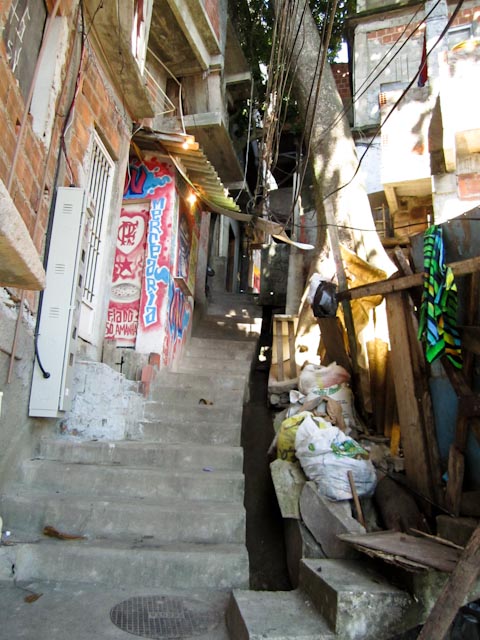
Narrow “street” in the Favela Morro do Cant

To clean up this image of out of control drug lord-run favelas the police are waging a serious war against the cri in the favelas.  People die literally everyday, sometimes by the dozens in shootouts with the police.  There are some Favelas that the drug lords “own”, meaning they are so well entrenched and armed that the police don’t even dare to enter because they know they would be killed.  There are other Favelas where the police are trying to win the battle.  If they “win”, the favela becomes known as “pacified”.  Right now, of the over 200 favelas in Rio, only 5 are considered pacified (the ones closest to the touristy areas).  Anyways, I could talk forever about this subject as it was so complex and interesting but….moving on…..

Favela Morro do Cantaga

To try and experience Samba we made a mission to go to one of the “Samba Schools” in Rio, of which there are 19.  They aren’t really schools but are more like clubs. These are the driving forces behind the famous Rio Carnival parade.  Most of their members and fans are people who live in favelas and they are almost all named after the favelas they represent.  In the months leading up to Carnival they have “rehearsals” every Saturday that are open to the public and are really just huge samba parties that the whole favela participates in.

So Safira and I set out one Saturday night to see the Manguera Samba School which was formed in 1928 and is one of the most famous.  A long bus ride from Ipanema dropped us off in a dodgy neighborhood at the edge of the Manguera Favela at about midnight.  After a hasty walk we found the party in full swing.  The music, people, and mass of energy was thick and in your face in a ghetto sort of way and that was just the scene outside of the huge warehouse that houses the samba party.   I was standing in line to buy our tickets when I turned and looked at Safira – the look of apprehension on her face said it all…so I escorted her to the bus back to Ipanema and made my way solo back through the crowds of people to buy my ticket.

Inside was much louder, more crowded and twice as much energy but with a surprisingly safe and family like general atmosphere.  About 60 percussionists pounded on drums of all sorts while a whole warehouse of people danced the samba, which i discovered is basically a form of who can vibrate and shake their body the fastest and most sexiest way possible, but with some good funny theatrics to go with it.  I finally left the party (It was still in full swing) around 5am and miraculously caught the bus back to Ipanema only to wake up the next morning with a hangover that only the beach could cure.

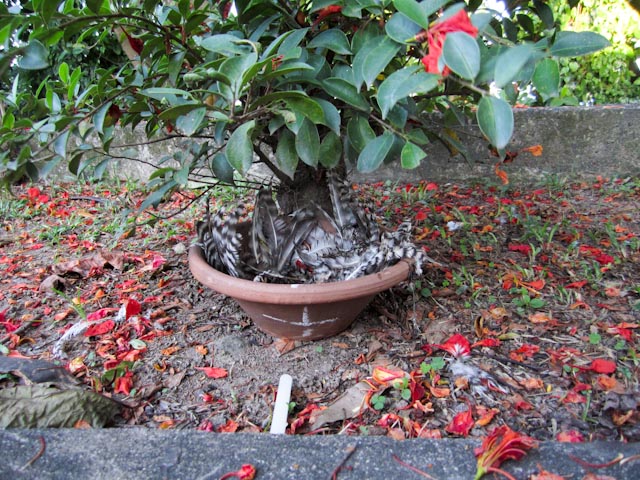
Rio was also my first real taste of the African Culture that makes Brazil so exotic and unique.  African slaves brought with them their own voodoo religion which mixed with Christianity and to this day is still practiced alongside of Christian rituals.  A huge percentage of the population belives in black magic and voodoo but its not practiced in the open although sometimes you see signs of it…

A dead chicken made as an offering possibly to cast a hex on someone…you see things like this from time to time on sidewalks or under trees

Other memories of Rio are:  The beginning of an addiction to coconut water (cold coconuts are sold EVERYWHERE and are chopped open with a machete and poked with a drinking straw), a visit to a little artists neighborhood called Santa Luiza that we fell in love with, taking a hike through Parque Nacional Tijuca (A beautiful national parque in the middle of Rio complete with rainforest and waterfalls), Fruits (Had the best mango in my entire life in Rio, Sucos (fruit juices from all types of normal and exotic fruits…they make them everywhere), and Açaí (An Amazonian fruit that is served frozen with granola and/or many other toppings and tastes amazing and gives you tons of natural energy), oh, and I fell in love with this old 1940’s Disney Cartoon about Brazil and Samba…a great one from the archives…if you have the time watch it….

Well, that’s about it for now.  This should have been posted on January 19th when we left Rio to begin the road trip up north.  The road trip has been one of the most amazing adventures of my life and I’ll be reporting more on that later but its not in the slightest conducive to keeping up with a blog since I rarely have internet access for more than short periods of time.  But I promise to get something up soon.  Until next time, Tchau!

PHOTOS: http://www.flickr.com/photos/59170494@N05/sets/72157626027558088/

Sao Paulo, New Years, and Ca-Dee Coco’s Maiden Voyage

With Christmas done and gone, memories of the party…travelers, beers, dancing, and drunken Christmas morning sunrises are all in the past.  All that is left, like scraps of wrapping paper under the Christmas tree, is a hangover and the need for a plan for New Years day which is quickly approaching.  Fortunately I had hopes to spend New Years in the company of old friends, Moose (AKA Jr.), and Porco (AKA Henrique).  My old roommates and partners in crime, I had lived with these two Brazilian cohorts for some time back in California in an old house in Hollywood.  A time that is lit with memories of house parties, hiking trips, Brazilian barbeques, wine on the roof, road trips to Las Vegas, and general merrymaking.  Four years had passed since they had left The States to return to Brazil and since I had promised I would visit them soon.  Better late than never, I alerted them of my presence in Brazil.  I can’t describe how great it was to be reunited with them, it reminded me of the joys of long overdue reunions, of the importance of friends and in keeping them in your life even if distances between you are great.  So Jr. and his girlfriend Vanessa, who he met when he was living with me in Hollywood and who I also knew from those bygone times, received me with welcome arms in their apartment in Sao Paulo (SP).  Henrique lived in a neighboring city an hour away and promised to drive down every chance he got.  And like this my adventures in Brazil began to take shape.

Reunited. Jr., Vanessa, Henrique, and me playing Pass the Pigs. Soooiiiiiieeeee!!!

So after the excitement of seeing each other again had wound down and we had sufficiently caught up over some nice dinners shared in their apartment with wine and candles we set off making plans for New Years.  No one wanted to stay in SP for this occasion so the next logical option was the beach.  Phone calls were made and research was done to reveal that of course there was no available places to stay in any of the beaches within two hours of Sao Paulo which sits about 50 miles (80k) inland. Hotels and hostels had all been booked months in advance.  I was about to feel dejected when Jr., always a sharp thinker, pointed out that Hotels are only good for sleeping in and besides that they cost money, why spent money on a hotel when we could just skip the sleeping part and spend the cash on Caiparihnas (kai-pur-EEN-ya)  purchased on the beach amongst the 1000’s of other revelers?  (A Caiparihna is kindof the national cocktail of Brazil, a mix of cachaça [Ka-SHA-sa…the national alcohol, a potent firewater made from sugar cane], a ton of lime, sugar, and ice.  Best drank in multitude and on a sandy hot beach.)

This ingenious plan was quickly adopted and put into action and Me, Jr., Henrique, Vanessa, and her Sister Bianca piled into the car and drove to Guarujá beach where all went as planned.  Thousands of people dressed in white (a Brazilian New Years tradition that symbolizes the purity of the year to come) filled a beach several miles long, fireworks and cachaça were abundant and kept us fueled until the sun rose straight out of the ocean, a site that outdid all the fireworks that preceded this grand finale and which was our cue to run like the drunken fools we were into the ocean to jump seven waves (another Brazilian new year’s tradition for good luck).  Swimming in the warm Atlantic waters, my brain contentedly bobbing inside my head, surrounded by an orange sunrise on New Year’s day, I realized that in all my travels around the world this was the first time I had ever swam in the Atlantic Ocean.  A fitting new adventure to start a new year.

Dinner before the fesitvities
Dinner before the festivities
The Scene on the Beach
The Scene on the Beach, the beach was 2 kilometers long and full of people and fireworks all night.
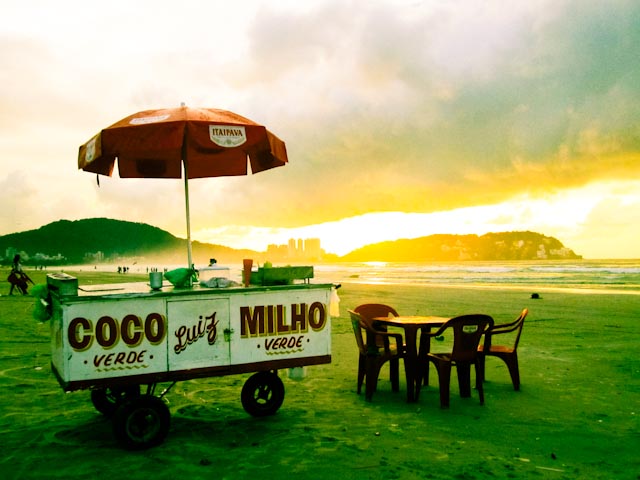
Abandoned corn vendor. Sunrise, just after a swim in the ocean.

Speaking of new adventures, one day the idea occurred to me that it might be fun to buy a car and drive it to Colombia…save on bus fare, pick up passengers along the way to add to the fun, and something I could sleep in to save money on hostels.  I brought the idea up with Jr. who was quick to point out that it isn’t possible to get a car across the Amazon River and who had his doubts whether a gringo could legally own a car in Brazil.  I had just assumed there had to be some sort of bridge or something but research confirmed that indeed, you could not drive along the Brazilian coastline and cross from one side of the Amazon Delta to the other in a car but that it was possible to legally buy a car if you were willing to brave some rather turbid beaurocratic waters.  Rather than give up on the idea I just decided that I could sell the car once I reached the Amazon and Jr. promised to help me navigate the seas of bureaucracy.  And so another harebrained scheme was put into effect.  Jr. went WAY above and beyond all normal duties of a friend in his dedication to helping me make this idea a reality and Henrique chipped in when he wasn’t stuck in the office in his neighboring city.  Ill spare you all the painful details of beaurocratic nightmares and hours spent looking for cars online and driving around Sao Paulo in the rain to check out the promising ones (Drove two hours one day to a dealer to see a car that was supposed to have 93,000 kilometers on it only to discover once I was behind the wheel test-driving it that there was a “1” in front of the 93,000….an observation that the car dealer claimed to have missed himself until I pointed it out to him), but I will say that it took more than a week, pretty much 6-8 hours a day dedicated to the cause, before I had the reins in my hands.  So without further adieu…allow me to introduce my travel companion.  Senora Ca-Dee Coco…

Zen And The Art of Driving Through Tropical Countries Without Air Conditioning

I bought it from a really cool guy who ran a paragliding school, hence the decals which translate into CLOUD-INVADORS.COM.BR,  SCHOOL OF FREE FLIGHT.  She has no stereo, no air conditioning, no power locks, doors, steering…well not much power in the engine either.  But she is the most roadworthy and reliable travel companion a vagabond could ask for.

So before I take you for a ride in the VW bus, let me speak a little of Sao Paulo.  After all, I did end up spending almost 3 weeks there including my 31st birthday (spent in the Chinatown district of SP at an all you can eat sushi place).  So how to describe it… Its big (seventh largest city in the world), there is lots of traffic, and it rains a lot, like every day and not just rain but proper storms complete with lighting and thunder that will shake the gringo right out of you and remind you that you are not in Kansas anymore.  The flora of the city is very tropical and green but it’s not hot, actually kind of cool at nights.  We did get one nice day in where the sun was out and we weren’t chasing cars and we spent it picnicking in the huge central park where monkeys swing wild from tree to tree and swans chase children across the grass.  The city is not so impressive compared to other metropolises but like any city it has its cool parts.  It was actually nicer than I expected it would be, I guess I expected to see more poverty.  That isn’t to say there isn’t plenty of it, but the central part of the city, which is huge, is all pretty nice and safe.  The poverty is far away in the surrounding favelas, a stark contrast to its sister city Rio de Janiero (more on that later).  I was actually surprised to read that SP is one of the richest cities in the world…I certainly felt like I needed to be rich to stay there.  I was shocked how expensive things were, a ride on a city bus was about $1.75 compared to the 35 cents I was used to in Buenos Aires, the two nights that I slept in a hostel before I met up with Jr. set me back almost $40.  Basically the prices are about the same as things in the US or Europe.  One day, just a couple days before I was planning to drive to Rio in the bus, we sat and watched the news as the rains pounded outside and the reports came in of devastation and death caused by unusually powerful storms in the states of Sao Paulo and Rio De Janiero.  When the rains let up and the damage was assessed we were all shocked to learn that over 600 people had died, the worst natural disaster in Brazil’s history.

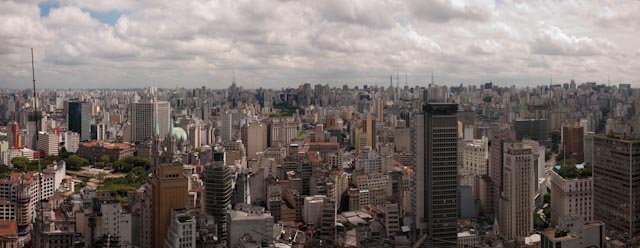
This taken from one of the tallest building in SP. I could only get the photostich program to stich 2 of the 4 photos i took, otherwise this would have been double the size. What you see here is only about 1/8 of a full panoramic view.

It was on the heels of this brutal storm that I finally set sail for Rio; I posted a message on the SP Couchsurfing group to see if anyone wanted to join me, that’s how I met Dave, an Irish lass who would be my crew on this maiden voyage.  So the plan was to drive to a small colonial town on the coast between SP and Rio De Janiero called Paraty (pronounced Par-ah-chee), spend the night there and the next morning exploring the nearby beaches and waterfalls, then finish the drive to Rio.  So I picked Dave up from his hostel, we shook hands for the first time and set off into the rainy Sao Paulo night with our trusty GPS nicknamed Ecowapi (Means “where is it” in Swahili, a remnant from my days spent wandering the mountains and deserts of Africa many moons ago) guiding us to our destination.  After a hectic escape from the rain and traffic of SP, Coco purred like a drunken kitten as we careened down the highway leaving me confident that I had chosen a good vehicle to deliver me to Amazonia.  After about 2 hours on the main highway Ecowapi had led us onto a small winding>>  highway that was to take us directly to the coast and to Paraty.  Winding and deserted as it was it wasn’t until it turned into a dirt road that we began to double check Ecowapi’s route.  But sure enough we were on our way. We could see ourselves on the map moving in the right direction and only about 25 kilometers from our destination.  Then the road became more difficult, heavy rains had carved holes and crevasses two feet deep into the red mud road and left giant rocks exposed, the kind that could shipwreck a VW bus if not navigated properly, oh, and did I forget to mention that the road was also steep?  Not just steep but roller coaster steep and we were pointed downhill (A good thing?).  By one AM, after about an hour and a half on this treacherous mud road we had gone about 8 kilometers (5 miles), we hadn’t seen another car in over two hours, and on at least three occasions had had to disembark the bus to find one wheel a half foot off the muddy ground.  On these occasions we would have to stick rocks under the tires or Dave would have to stand on the bumper and bounce up and down so the tires would get traction while I gunned the engine.  So there we were with windows down, dim headlights struggling to illuminate the road ahead, bumping along at about 2 miles an hour surrounded by jungle and jungle sounds and jungle smells.  And so sometime after one in the morning we decided to call it quits for then night.  There were certainly no other idiots on this road other than ourselves so without worrying of blocking the road we put the car in park, turned off the engine and stepped out into the tropical night to breath in the reality and adventure of it all before we crawled in the back of the bus cursing ourselves that neither of us had a drop of cachaça to share with the other and fell asleep.

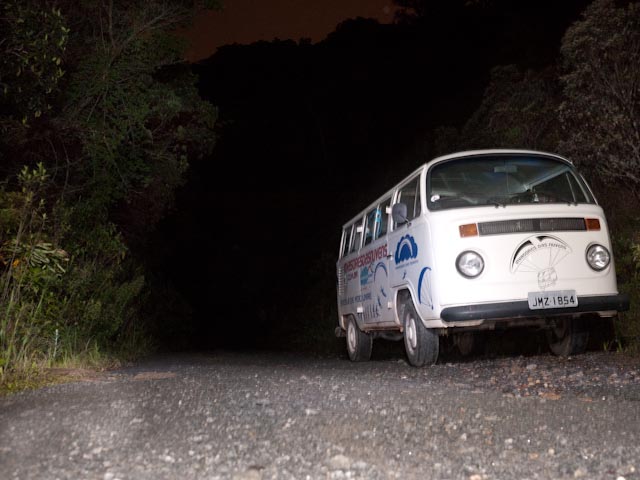
Parked for the night

We woke up with the sun and shoved off without ceremony.  45 minutes and 3 kilometers later a car appeared in the rear view mirror, another idiot!!! We were shocked and overjoyed to see that this car, a 1970’s Volkswagen beetle was gaining on us.  We slowed to a stop to let him pass us, our mouths agape at the lighting speed of 3 miles per hour at which he passed us.  With confidence renewed we followed our Volkswagen brethren down the road, now amazed to see the stunning beauty and breathtaking scenes of cliffs, jagged mountains, waterfalls and dense jungle that had been hiding from us the night before.  As for the road it got no better or easier to navigate.  We still got stuck frequently and constantly had to get out to asses which of the less treacherous gaps to tackle.  Then, all of a sudden, with about 12 kilometers to go on the GPS, we turned a corner and found the road paved. We were saved.

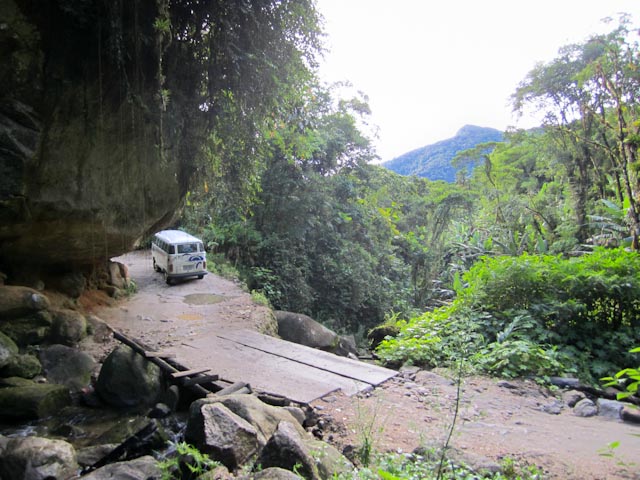
There was a beautiful waterfall just to the left of the picture, and precarious cliff off to the right.
Our Volkswagen Friend

And in 5 minutes we went what would have taken us over two hours and we were in Paraty!  So we stop at a hostel to ask some touristy questions and in passing Dave mentions that we had just arrived by car from Sao Paulo.  “Oh from Sao Paulo huh?, beautiful drive along the coast isn’t it”?  Says the man.  The look on our faces would have sufficed to tell the tale but I managed to say “Uhhh, we didn’t take the coast” this reply brought a knowing grin across the man’s face proceeded by a chuckle and his reply…. “GPS right?”, “Yea” we answer, waiting for his punchline which comes…  ” ‘Shortest route possible’ “?

So after we laughed off our near disastrous adventure we set off to explore our new paradise.  The town was picturesque and colonial, just as described in Dave’s guidebook.  Narrow cobblestone streets that flood when it rains leaving a glassy river of water have earned it the name “The Venice of Brazil”.  The town was great for photographs and a nice walkthrough but we were eager to find a beach worthy of drinking a beer on so we piled back into Coco, picked up provisions at a local market and headed to some tiny beach where we passed some time swimming with the locals and hanging out on the beach.  From there we made several other detours off the main road to other smaller more deserted beaches and one beautiful waterfall that was a short drive off the main road and about a 1 kilometer hike through a jungle trail.  We were the only people there and I thought to myself….This is why I bought a car…total freedom!

Paraty
One of 4 beaches we stopped at along the way
Only a small part of the waterfall, there was much more above and below this.

We finished the day driving the rest of the way to Rio, arriving just in time for the evening rain flurry and rush hour traffic but Ecowapi guided us well through the outskirts of the city and into Copacabana beach where Dave had booked a bed at a hostel.  I thought I had a couch lined up for my first days in Rio but when I checked my email at Dave’s hostel I found that my host hadn’t gotten back to me with an address.  It was Friday night and Dave’s hostel was booked and i really didnt want to sleep in the bus in such a big city.  There are dozens of hostels in Copacabana I thought; surely one will have a bed.  I probably covered 20 blocks and hit 10 hostels, all full.  At almost 2am I found a newspaper in the street, taped it to Coco’s windows (I still hadn’t put up the curtains I had made) and spent my first night in Rio sleeping in the bus.  I awoke the next morning to the bustle of Rio De Janiero where I have spent the last 10 days comfortably forming the opinion that it is one of the most dynamic and interesting cities in the world.  But alas, I leave you there, on the streets of Copacabana in the early morning tropical heat, Ate em breve,

PROLOGUE:  I arrived Copacabana on January 14th…as you can see Im a bit behind in my blogging.  I’m currently in Salvador, Bahia.  I hope to get another blog post out this week.  To see more pictures from this post click here: http://www.flickr.com/photos/59170494@N05/sets/72157625989025748/

LA RUTA DE COCO

Argentina, Paraguay, & Christmas in Brazil

“We live in a wonderful world that is full of beauty, charm and
adventure. There is no end to the adventures we can have if only we
seek them with our eyes open.” – Jawaharial Nehru

The adventures have certainly picked up steam since my last post and the road ahead seems to be littered with more adventures ripe for the picking.  My last post was from Mendoza Argentina, wine country.  The city of Mendoza is rather large by Argentina standards and although it is a really pleasant, clean and nice city to walk around in, there is no real attraction other than the surrounding vineyards and mountains (It’s at the foothills of the Andes).  Everything closes at 1pm for siesta and to avoid the heat and then reopens at around 5pm.  At 9 or 10pm the main streets are still filled with people shopping for shoes and clothes or running errands.  I spent almost a week in Mendoza trying to scrounge up some work in a vineyard or tasting room but there was no work to be had for a foreigner without papers. Even though I was willing to work for food and housing, all the proprietors I spoke with said that the authorities would never believe that I wasn’t getting paid and they didn’t want to invite trouble.  So after several days of hunting for jobs I threw the Spanish resume in the trash and decided to enjoy the wine as it should be enjoyed in Mendoza, in abundance and on bikes.  As much as I love traveling alone, drinking glass after glass of wine in the middle of the day seemed like something better done with a partner in crime…enter Mademoiselle Flo. Also a couchsurfer, Flo was on a 6 week jaunt through Argentina from her home in France.    So we rented bikes and rode around the wine country outside of Mendoza for an afternoon sampling the local goods (some not so good).   We got along swimmingly and since we were heading in the same direction we ended up traveling together for the rest of the week.

I also had the luck to couchsurf in Mendoza with a guy named Horacio who really made my time in Mendoza memorable.  Haracio is from a small town in Argentina in the mountains but is in Mendoza studying graphic design.  I met some of his friends and spent a couple of great nights cooking, drinking beers, and playing music.  One night we spent hours experimenting with taking pictures with extra long shutter speeds until we finally got one that turned out pretty cool…

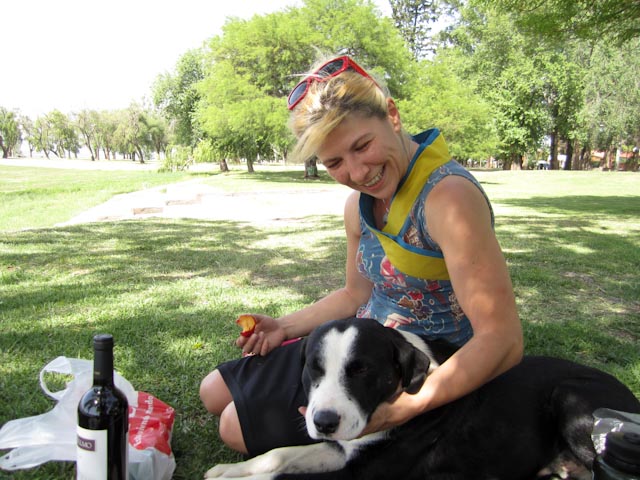
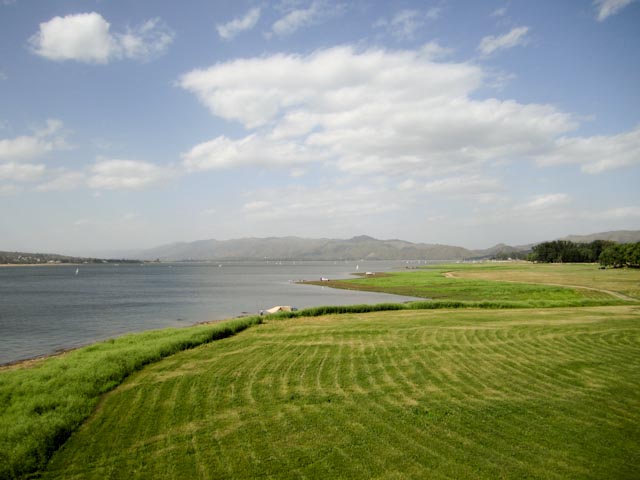
From Mendoza I went to Cordoba, the second largest city in Argentina and a major commercial and industrial city.  Really thought the main reason to visit the city for me was to use it as a hub to explore the surrounding sierras, a virtual outdoor playground of mountains, rivers, lakes, and trails.  Flo was also heading that direction so I met up with her there and shared some more dinners, cheap wine, and adventures…one of which brought us to a small town called Carlos Paz, a day trip from Cordoba.  The town’s main attraction is a 25 foot tall Coocku clock and the lake that it sits on but for us it was a street mutt who befriended us while we were picnicking alongside the lake.  We named him Coronelito Paz.  We spent hours walking around the lake and through the city with him following us around playing fetch with whatever stick we could find and jumping in the water together.  And then as quickly as he appeared in our lives he was gone…trotting off down the sidewalk in search of his next diversion.  Wherever you are right now Coronelito, we miss you.

Coronelito Paz
Villa Carlos Paz
Villa Carlos Paz


The highlight of my time in this region and the whole reason I was there was to do some camping in the sierras.  So after a bit of planning and packing I said goodbye to flo who was heading back to Buenos Aires and I set off with a backpack full of food and wine in search of mountaintops to eat on top of and stars to drink under.  The first night I spent camping in Parque Nacional Quebrada del Condor.  I hiked into the park about a mile and half, threw my big pack down and then did a loop that took me another 8 miles or so past a huge 2000 ft. (600m) cliff where there are dozens of Andean Condors nesting and circling around.  Luckily it was a warm day so there were a few of them riding the heat thermals.  They have the largest wingspan of any bird on the planet (can reach 11 feet [3.2 m]).  After a long day hiking I settled down for the evening in a small grassy clearing.  I was the only person camping in the whole park which was nice. I spent the evening drinking wine to forget my surprise at how cold it was.  I didn’t have a tent so slept out under the stars and woke up feeling surprisingly fresh and covered in frost.

  • Cliffs at Parque Nacional Quebrada Del Condor
  • Hiking back to the road as the sun rose
    El Condor Pasa
    Waking up with the sun

    I hiked out of the park back to the main road where I spent about an hour and a half throwing rocks at cans and reading while trying to hitch a ride to the next town.  (there aren’t really and buses in this area and it’s not uncommon to hitchhike).   My first ride was a guy who owns a restaurant; he drove an old 78’ Chevy pickup truck all rusted out. The seatbelt had been cut so it could be used as a rope to hold the passenger door closed.  We bumped down the highway chatting about how indecent Argentine curse words are and he taught me a few new ones.  He dropped me at a fork in the road and my next ride was a cool truck driver hauling 48 cows behind him.  We drank mate and talked about all sorts of things.  He dropped me in a town called Nono.  From there I hiked out of town to a nearby river.  I bought a cold beer (All they had was Budweiser) at a little kiosco on the way and drank it with my sandwich while hanging out in the sun on the bank of the river sharing the breeze with a bunch of cows that frustratingly would not let me pet them.

    From there it was back to the highway, rock and can games, sun beating down on my neck and dirt in my ears for a while until I got a ride from a couple of guys from Quilmes to a town called Cruz Del Eje.  By the time I got there it was nearly 9pm and I got the last bus to a town about a half hour away called San Marcos Sierra, known for being a super laid back very small “hippie” town of about 2,000 people.  I got off the bus at the “main square” around 10:30pm to find an American folk band playing on a little stage to a plaza full of beautiful hippies (Really, the people were all extremely good looking, some of the most beautiful women I have ever seen).

    I slept that night in the municipal campgrounds two blocks from the main plaza and 100 yards from a small river that runs through the town.  I sat up in my sleeping back at about 7am squinting in the early morning light and saw two scrubby looking guys sitting at a park bench signaling for me to come over.  So I climbed out of my sleeping back, put some clothes on and cruised over to my friendly neighbor’s campground.  They were a couple of Argentinean kids in the early twenties.  In lieu of sleep they had opted to spend the whole night drinking wine mixed with coke out of a two liter plastic bottle that they had cut in half with a pocket knife.  The wine along with a joint were promptly offered to me along with enthusiastic stories of their adventures climbing a nearby hill that they had conquered barefoot to watch the sunrise.  The hill and its immense size along with all their scratches and scrapes from bushes and thorns were pointed out to me about a half dozen times in 5 minutes.  After lots of high fives and thumbs up they let me go back to my stuff which I packed up and threw on my back to head towards a place called Tres Piletas, about a 5 mile walk down an extremely hot and dusty road out of town to a little oasis in the middle of a very desert environment with sparse thorny vegetation.  I spent another night here sleeping out and swimming and trying to keep in the shade and enjoying the fact that I was the only person camping there before I packed up and headed back to the big city plan the next adventure.

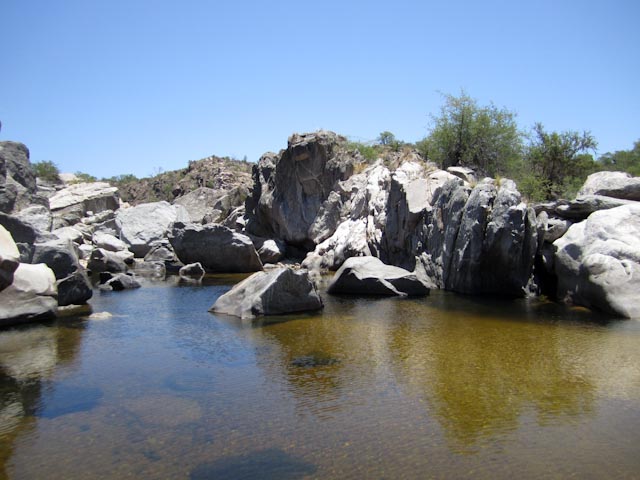
    Tres Piletas, the Desert Oasis

    Speaking of next adventure…what do you know about Paraguay?   That was the question I had been putting to Argentines and other backpackers for several weeks.  If you tried to answer the question in your head as you read it, the answer was probably the same that I got “not much” or “Nothing”.  The only thing that Argentines could tell me about it is that that is where they go to buy cheap electronics, just crossing into a border city and then immediately crossing back.  One day when I was in a hostel in Cordoba I asked to borrow someone’s guide book, The Lonely Planet South America – basically the backpacker’s bible…the book everyone uses.  I flipped through searching for the Paraguay section hoping I could fill some holes that everyone else had left open and was shocked to find that there was none!  The Lonely Planet South America just skipped Paraguay because there is no tourism and no one ever goes there.  So my mind was made up then and there.  I was going to Paraguay.   Only problem was that I wanted to be in Sao Paulo Brasil for Christmas and still needed to stop to check out Iguazu on the way so I only had a few days to spare.  Nevertheless my mind was made up so I headed north.

    After about 20 hours on buses I landed myself in a small town on the border of Argentina and Paraguay called Clorinda.  From some internet research I knew that US citizens had to pay $50 for a visa to get into Paraguay, but I had also heard that if you are sneaky enough to find a way to bypass the somewhat lax immigration control at the border that you could avoid this.  So I got off the bus in Clorinda and wandered a few blocks from the terminal, feeling with certainty that I was the only gringo who had stepped foot into this town for quite some time.  I found a few guys drinking beers on the sidewalk and asked them what they knew about getting past the customs.  They said they knew it was possible but they didn’t know how.  Then a kid about 10 years old, barefoot, dirty, dark skin and dark curly hair came up and assured me he could lead me to Paraguay safely.  I was confident I could play the dumb gringo role well if any trouble arose (I wouldn’t have to act so much) so I asked him how much.  “Cinco Pesos” he said.  Ok, lets go.  So I followed him a few blocks until we reached a little hill that led to a road where I was instructed to wait for his signal when the coast was clear.  The signal came and I started up the hill –WAIT! Hold on! – was the message I got when I was almost at the top….a car was coming, then again I got the green light so scramble up the rest of the way.  What I saw in front of me was a river and on the other side of it was Paraguay.  I looked to my right down the street that ran parallel to the river and there, about 400 meters away was the immigration with a short line of cars stacked up crossing the border and guys in uniforms walking around.  I didn’t have much time to take this in because my coyote was tugging at my sleeve and pointing to the small wall I needed to climb to begin descending to the bank of the river.  And sure enough, the little kid knew where a little makeshift bridge was made out of wood planks suspended over bricks and rocks that sat in the shallow waters of the river and so I hastily ran across the planks bouncing up and down with two backpacks and a ukulele strapped to my body.  And then, I was in Paraguay.  The little kid led me through a bunch of shacks, chickens and pigs clearing a way for us and local people peaking out of their homes to see the spectacle until we reached a little bus stop, where I was told I could get a ride to Asunsion, the capital just 40 minutes away.

    Paraguay Flag
    • Paraguay FACTS:
    • Exchange Rate- $1 US = $4,600 Guarani
    • Beer in Grocery Store (1ltr.) – $ 1.65
    • Cheap Meal – $2.00
    • 5 hour bus ride – $11
    • Second poorest country in South America (next to Bolivia)
    • Has two official languages, Spanish and Guarani.  Once you get out of the capital you almost only hear Guarani although many people still speak Spanish

    So I only spent a few days in Paraguay since I was in a rush to get to Brazil but I feel like I got a decent idea of what things are like there.  So for all those people who I asked what there is in Paraguay…There is really green landscape with red dirt that reminded me of Africa sometimes, there is Sopa Paraguaya (A bread made from corn meal, animal fat, and cheese), Chipa (A pastery made from corn meal and cheese), there is a lot of yucca root and beef and of course tereré which is mate, just like they drink in Argentina, but they drink it cold.  There are a lot of people sitting in chairs that they drag out to the front porch of their house to sit and drink tereré for hours complaining of the heat, ah yes, and there is heat lots of heat.

    My memories and observations of Paraguay are drawn from my experiences in the capital, Asunsion where I spent a night in a dodgy hotel room near the bus terminal (there are no hostels In Paraguay), on a bus where I sat next to a really amazing Paraguayan psychologist who volunteers with children and who spent 3 hours teaching me everything about Paraguay, a short stay in a small city called Caaguazu, and my time with Angelíc in small city called Coronel Ovieto.

    Laundry Day in Hotel Room Near Bus Terminal, Asunsion, Paraguay

    When I did a “couchsearch” for the whole country of Paraguay there were 100 people that came up, more than I would have thought, but only a couple were in cities that I would pass through.  One of them was Angelíc, an American Peace Corps volunteer who has been stationed in Coronel Ovieto, Paraguay for almost two years now.  Her time with the Peace Corps is almost up but she is enjoying Paraguay so much she is going to extend her time one more year. I stayed with her one night and she downloaded me on all her observations of the culture while we sat in front of her house drinking tereré, watching the sun set and the dogs chase the cars while nipping dangerously close to their tires as they passed.  One of the most interesting things that I learned was the importance of co-ops in the daily life of a Paraguayan.  Even after lots of questions and explanations from Angelíc I’m still not sure I completely understand the way these work into things…it seems like a complex convoluted subject.  But basically almost everyone joins at least one co-op here that could offer services from money loaning, health insurance, schooling, homeowners insurance, etc.  There is a co-op for just about anything.  I asked Angelíc if they were necessary or useful.  Her answer was not a surprise to me, “No, if people would just learn to save their money they would be better off not being part of a co-op, they waste their money on these co-ops which are more often than not mismanaged and dishonest.”

    Coronel Ovieto, Paraguay
    Coronel Ovieto, Paraguay
    Cemetery in Paraguay

    So my brief time in Paraguay led me back into Argentina to a town called Puerto Iguazo on the border of Paraguay, and Brazil.  This is the hub for exploring the famous Iguazu Falls.  I wont say much about the falls, will let the photos do more of the talking.  I will say that it they exceeded my expectations.  Someone I had met in a hostel some weeks before had described it as like being in the movie Avatar and its true, it’s like being in some magical fantasy world created by CGI graphics.  Waterfall after waterfall pouring over huge cliffs surrounded by vivid green rainforest full of monkeys and coatimundi (like a South Americna raccoon).  There are rainbows everywhere and swarms of butterflies.  It was unreal.  I wasn’t lucky with the weather unfortunately.  I was only there about an hour and a half before the rain started and never let up so I missed seeing a lot of the most spectacular views while the skies were dry so my pictures of the falls are limited compared to what I could have had if the weather would have cooperated but they at least give you an idea.

    Iguazu Falls
    Iguazu Falls

    From Iguazu I traveled about 18 hours to Sao Paulo Brasil, arriving on Christmas Eve.  BRAZIL!!!  I had finally arrived.  I had the afternoon to kill before I met my couchsurfer and it being Christmas Eve the city was empty and dead.  I took the metro to the neighborhood where she lived and wandered around a bit until I found an old abandoned building that I ducked into.  I spent most of the afternoon there reading and studying Portuguese (my new worst enemy) until it was time to meet Nina, my CS host who turned out to be a true force of positive energy, warmth, and smiles.  I met some of her friends and then we spent some hours just chatting and passing time.  Unfortunately that was about all the time I had with her since we were going different ways that night and the next day she was heading to another state in Brazil to be with the rest of her family.  But I am planning to meet up with her upon her return so hopefully we’ll get to spend more time together then.

    Abandoned Building, Christmas Eve, Sao Paulo

    I had read a post on couchsurfing about a French guy who lived in Sao Paulo and was holding an “Orphan’s Christmas Party” So I spent Christmas Eve partying with a diverse group of Brasilians and travelers from all over the world.  Dancing, crazy French football traditions of diving onto your friends who are seating on the floor and hoping that they catch you, and lots of conversations in lots of languages.  I left the party at about 6am on Christmas morning.  I had about 20 blocks to walk back to my couchsurfers.  And as the sun rose over one of the largest cities in the world, I walked through its empty streets on Christmas Day.  So unlike any Christmas I have ever spent, but one I will definitely never forget.

    Click here to view photos from the last month:

    http://www.flickr.com/photos/56658782@N07/sets/72157625690833844/

    Prologue:  I last left off in Mendoza, Argentina where I spent some time wine tasting and looking for a job that never transpired.  I spent some time hiking through and camping in the Sierras in the Cordoba Province of Argentina.  Then I heading North into the mysterious counry of Paraguay for some days before I crossed back into Argentina to check out Iguazu Falls, one of the largest waterfalls in the world.  From there I went to Sao Paulo Brasil to spend Christmas.  Im still in Sao Paulo and am in the process of trying to buy a car that I can drive through Brasil up to the Amazon.  Next destination from here will be Rio De Janeiro!